
'We continue to believe that the global economy will narrowly avoid a recession, despite expecting the US, Canada, and most of Europe to fall into recession at some point over the next year or so.'

'We had tremendous faith in honorable Modiji in his second term as he was well-settled. Sadly that has been belied.'
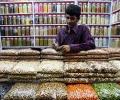
Credit rating agency Crisil observed in its report that some 'high frequency indicators go out of whack' as credit growth and service tax collections are not in tune with the CSO's growth projections.

Progress of monsoon, investment trend by foreign investors and the movement of rupee against the dollar will also influence sentiment
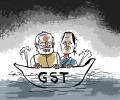
The collections stood at Rs 98,202 crore in the month, against Rs 1.02 trillion in July. The figures indicate continuation of economic slow down which was reflected in the gross domestic product (GDP) growth which plummeted to a 25-quarter low of 5 per cent in the first quarter of 2019-20, experts said.

Credit growth in the industrial sector has slowed down due to sluggish economic growth.

China's economy is in transition, with rising wage costs and massive overcapacity.

Participants are keenly waiting for the January IIP.

An unhappy, restive mood prevails at the Ford factory Maraimala Nagar, 50 km from Chennai, and the surrounding area. The security is tight - not just Ford security personnel but also Tamil Nadu state police who are posted at the main gate. From September 9, when Ford India announced it was phasing out its units in India and leaving, workers at its manufacturing unit at Maraimala Nagar have held onto one hope: that the state government will step in to save their jobs.
'At this point, it does not appear to be a Lehman Brothers kind of crisis, which had a domino effect on the financial system.'

'The new government will have to contend with slowing economic growth, weak private investment, anaemic exports and vulnerable external imbalances, a stressed financial system, mounting fiscal pressures (including high government debt-to-GDP ratios) and an exceptionally bad employment situation,' says Shankar Acharya, former chief economic adviser to the Government of India.

The central bank's currency management will be critical over the next few months. A weaker rupee could help to revive exports. But, the currency must fall slowly and in controlled fashion, says Devangshu Datta.

Growth numbers for the large players in the sector, though, improved during the quarter.

The first half of 2019-20 will be under pressure, since prices are expected to go up by Rs 7,000-8,000 at a time when sentiment is poor.

In the April 2012-February 2013 period, the life sector's industry's new business premium collections fell 6.1 per cent, compared to the corresponding period of the previous financial year.

RBI must balance the need for improving domestic bank credit demand and respond to lower inflation.

The fiscal deficit of the Centre remains a worry, running at over 6.5 per cent of GDP in April-September 2014, mainly because of revenue shortfalls from exaggerated projections in the government's July Budget and despite the relief on subsidies from lower oil prices.

Investment in market leaders with a safety-first approach could yield reasonable returns across sectors.
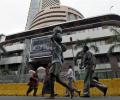
The market players are expected to react to the better than expected factory output data for the month of August, which revealed that the industrial production grew by 6.4%.

'There has been far too much overconfidence about the size and composition of the Indian consumer economy,' notes Mihir S Sharma.

The total value of India's top 100 brands has increased by 2 per cent, from $162.1 billion in 2020 to $164.9 billion in 2021, according to the latest Brand Finance India 100 2021 report. This uplift in brand value over the course of the first year of the pandemic is an impressive feat given the global economic crisis following the implementation of national lockdowns in March 2020, when business activity was brought to a halt, affecting both production and consumption. Among the brands that came on the top of the list include Tata Group, Reliance Industries, and Mahindra Group.

Expectations were probably too high from Narendra Modi.

The government will release the Index of Industrial Production for July 2015 on Friday, September 11, 2015.

Perhaps half-way through India's demographic transition, what is the outlook for the future?

India's GDP may turn positive at 1.3 per cent in the third quarter of 2020-21, having witnessed contraction in the previous two quarters due to the coronavirus pandemic, as the number of cases is falling and public spending has started rising, according to a report. The government will release the GDP numbers for the October-December quarter of the current fiscal on Friday. Projecting that the gross domestic product (GDP) may have returned to the black in the last quarter of the calendar year 2020, DBS Bank in the report said the full-year growth in real terms may be at a negative 6.8 per cent.

They believe that the key reason behind such a high growth rate could be "a steep downward revision" of the year-ago base period.

India Inc's quarterly net profit reached a record high of Rs 1.64 trillion in the third quarter ended December 31, 2020, mainly due to gains from higher commodity prices and a big swing in banks' earnings. The combined net profit of 3,323 listed companies that have declared results so far was up 68.6 per cent year-on-year (YoY). In comparison, earnings were up six times (534 per cent) in the second quarter and 6.5 per cent in the corresponding period last year.
The optimism in global markets could help India as the rebound in GDP is expected to continue and get more broad-based.

The pace of job generation has slowed as IT firms look at automation to do testing

Giants like Pepsi and Coke are fast losing shelf-space to healthier, functional options.

That resulted in a 50-basis point improvement in operating profit margins on a sequential basis.
PSU bank shares were the top gainers on hopes of a rate by the RBI on easing consumer inflation

Out of 30 key export sectors, as many as 22 showed negative growth in September.

The government has made its initial moves, good and not-so-good, while the roll-out in some cases has been slow.

Given the relative rates of gross domestic product growth, the differential will increase.

'Clearly, the next few months will be very challenging for industry.' 'We are clearly in a phase where recovery is a dream.'

The good news for PepsiCo is that the foods segment has normalised much faster to pre-pandemic levels than beverages.

'Without reviving employment, consumer confidence will not go up.'

Over to the government how they manage the uncertainty of monsoon and revive spending in order to entice RBI for another round of rate cuts

Benchmark share indices opened lower on Monday, amid weak global cues, as investors turned cautious ahead of the US Federal Reserve stance on interest rate.
